
Polynucleotides Explained
Polynucleotides (PN) are biopolymers derived from purified DNA fragments, typically sourced from salmon or trout DNA chosen for their exceptional compatibility with human tissue. These molecules are already naturally present in our cells, playing a fundamental role in repair and regeneration.
When introduced into the skin via injection, they trigger the body’s own healing mechanisms: stimulating fibroblast activity, encouraging collagen and elastin production, and supporting tissue repair at a cellular level. Unlike traditional dermal fillers, which physically add volume, polynucleotides work quietly beneath the surface rebuilding the skin’s architecture from within.
How They Work
Understanding the science behind polynucleotides helps clinics communicate confidently with patients. The treatment works across four primary biological pathways:
Fibroblast Stimulation
Activates the cells responsible for producing collagen and elastin, rebuilding the dermal scaffold.
Hydration Boost
Improves the skin’s ability to retain moisture, restoring plumpness and a healthy glow from within.
Tissue Repair
Supports cellular regeneration, making PN ideal for sun-damaged, stressed, or post-procedure skin.
Anti-Inflammatory Action
Reduces inflammation and oxidative stress, calming reactive or sensitised skin conditions.
The Trend Driving Demand in 2026
Several converging forces have pushed polynucleotides to the top of patients’ treatment wishlists this year.
The “Glass Skin” Movement
Driven by Korean aesthetic medicine long renowned for prioritising skin health over structural change the global demand for smooth, luminous, naturally radiant skin has never been higher. Polynucleotides are the clinical expression of this philosophy.
The Post-Filler Correction
After years of patients seeking dramatic volume enhancement, there is a growing trend toward correction and restraint. Many patients want to undo or tone down previous filler treatments and focus on skin quality instead. Polynucleotides offer a compelling alternative path and one that complements reversal treatments beautifully.
An Ageing Population Seeking Subtlety
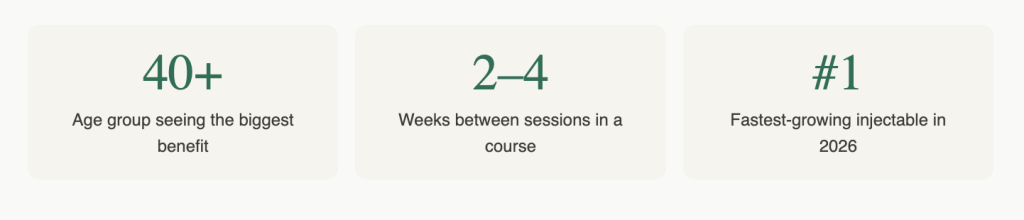
Patients in their 40s, 50s, and beyond often have concerns that dermal fillers don’t fully address: thinning skin, poor elasticity, and loss of collagen density. Polynucleotides are scientifically designed to tackle these root causes. The results are natural, progressive, and clinically meaningful exactly what this demographic is seeking.
What Patients Can Expect
Results develop over a course of treatments and continue to improve as the skin regenerates. Clinically, patients report:
- Smoother skin texture
- Improved hydration
- Firmer skin
- Reduced fine lines
- Improved elasticity
- Brighter complexion
- Calmer, less reactive skin
- More even skin tone
It’s important to set accurate expectations: polynucleotides are not a quick fix. The treatment works progressively, with results typically becoming visible 4–6 weeks into a course and continuing to develop for several months thereafter. Patients who complete a full course and commit to maintenance sessions see the most significant long-term improvements.
Injection Techniques
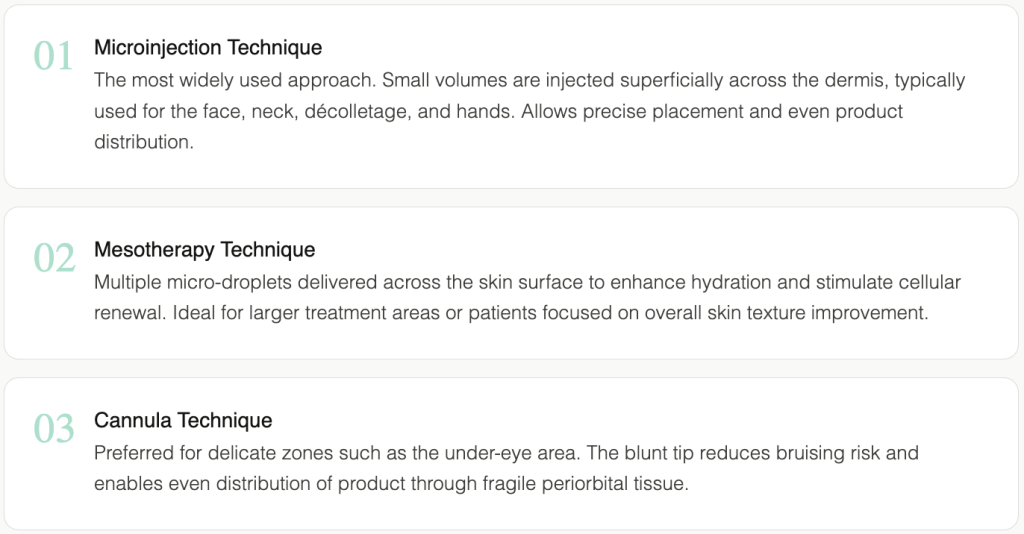
Polynucleotides can be administered using three established techniques, each suited to different treatment areas and clinical preferences:
Injection Techniques
Polynucleotides can be administered using three established techniques, each suited to different treatment areas and clinical preferences:
Microneedling / Nappage A series of small, superficial injections delivered across the treatment area in a stamp or fanning pattern. This technique ensures even distribution of the product and is particularly well-suited to the face, neck, and décolletage. It is often favoured for patients new to polynucleotides, as it allows a thorough and comfortable treatment across a broad surface area.
Linear Threading The needle is inserted into the skin and the product is deposited in a continuous line as the needle is slowly withdrawn. This method is ideal for targeting specific areas of concern such as fine lines, the tear trough region, or along the jawline where precise placement delivers the most clinical benefit.
Bolus / Depot Injection A small amount of product is deposited at a single point in a concentrated depot. This approach is useful in areas that require a more focused intervention, such as the periorbital area or localised zones of tissue thinning. It allows the practitioner to direct biological activity to exactly where it is most needed.
Many experienced practitioners will combine techniques within a single session, adapting their approach to the patient’s anatomy and treatment goals.

Treatment Protocols
A typical polynucleotide course consists of two to four sessions, spaced two to four weeks apart. The exact protocol will vary depending on the brand used, the area being treated, and the individual patient’s skin condition and desired outcome.
Initial Course Most patients begin with three sessions to establish a strong foundation of cellular regeneration. This primes the tissue and sets the stage for continued improvement between appointments.
Maintenance Following the initial course, maintenance sessions every three to six months help sustain results and continue to support the skin’s natural renewal processes. Patients who invest in maintenance typically retain their results significantly longer than those who do not.
Combination Approaches Polynucleotides pair exceptionally well with other aesthetic treatments. Many clinics incorporate them alongside:
- Hyaluronic acid skin boosters, to combine deep hydration with regenerative benefit
- Microneedling, to enhance absorption and amplify collagen induction
- Radiofrequency or ultrasound treatments, for patients seeking additional structural tightening
- Post-filler maintenance, to improve skin quality in areas where volume has been added or dissolved
Which Areas Can Be Treated?
Polynucleotides are highly versatile and can be used across a wide range of areas on the face and body:
- Face — full facial rejuvenation, targeting texture, tone, and fine lines
- Periorbital area — one of the most popular indications; PN is well-tolerated in the delicate under-eye zone where fillers carry greater risk
- Neck and décolletage — areas often neglected in traditional filler protocols but highly responsive to PN
- Hands — improving skin quality and reducing the crepey appearance that comes with age-related collagen loss
- Scalp — an emerging application for patients experiencing hair thinning, where PN supports follicle health and micro-circulation
Safety Profile and Contraindications
Polynucleotides have a well-established safety record, supported by decades of clinical use in regenerative medicine across Europe and Asia. Because they are biocompatible and biodegradable, adverse reactions are rare.
Common side effects are mild and transient, typically resolving within 24 to 72 hours:
- Redness and swelling at injection sites
- Minor bruising
- Temporary firmness or nodularity (particularly with bolus technique)
Contraindications to be screened for prior to treatment:
- Known allergy to fish or seafood (relevant for salmon/trout-derived products)
- Active skin infection or inflammation in the treatment area
- Autoimmune conditions or immunosuppressive therapy
- Pregnancy and breastfeeding
- History of keloid scarring
As with all injectable treatments, a thorough consultation and medical history review should precede every course of treatment.
Why Polynucleotides Belong in Every Clinic
The aesthetic landscape is shifting. Patients are better informed, more discerning, and increasingly motivated by long-term skin health rather than immediate visual change. Polynucleotides sit at the intersection of science and subtlety delivering measurable, clinically meaningful improvements without the risks or tell-tale signs associated with volume-based treatments.
For clinics looking to differentiate, polynucleotides offer a powerful proposition: a treatment that works with the body’s own biology, builds trust through progressive results, and speaks directly to where patient demand is heading.
Skin Boosters
-

Plenhyage XL Medium
£70.00 -

Plenhyage XL Strong
£65.00 -

Plinest 2ml
£60.00 -

Plinest Fast
£68.00 -

PN Eyes
£24.00 -

Profhilo 1 X 2ML SYRINGE
£75.00 -

Pure Eyes PN Booster
£20.00 -

Regenovue Aqua Shine Plus
£40.00 -

Revitrane HA20 Skin
£54.00